Biography
Eugene Bertram Krupa (January 15, 1909 – October 16, 1973) was an American jazz drummer, bandleader, and composer. Krupa is widely regarded as one of the most influential drummers in the history of popular music. His drum solo on Benny Goodman's 1937 recording of “Sing, Sing, Sing” elevated the role of the drummer from that of an accompanist to that of an important solo voice in the band.
In collaboration with the Slingerland drum and Zildjian cymbal manufacturers, he became a major force in defining the standard band-drummer's kit. Modern Drummer magazine regards Krupa as “the founding father of modern drumset playing”.
Upon his death, The New York Times labeled Krupa a “revolutionary” known for “frenzied, flashy” drumming, with his work having generated a significant musical legacy that started “in jazz and has continued on through the rock era”.
Krupa made his first recordings in 1927 with a band under the leadership of Red McKenzie and guitarist Eddie Condon. Along with other recordings by musicians from the Chicago jazz scene, such as Bix Beiderbecke, these recordings are examples of Chicago-style jazz. Krupa's influences during this time included… Father Ildefonse Rapp and Roy Knapp (both teachers of his), and drummers Tubby Hall, Zutty Singleton, and Baby Dodds. Press rolls (dragging one stick across the snare head while keeping the beat with the other stick) were a fairly common technique in the early stages of his development. Many other drummers (Ray Bauduc, Chick Webb, George Wettling, Dave Tough) influenced his approach to drumming, and other instrumentalists and composers such as Frederick Delius influenced his approach to music.
Krupa appeared on six recordings by the Thelma Terry band in 1928. In December 1934, he joined Benny Goodman's band, where his drum work made him a national celebrity. His tom-tom interludes on the hit “Sing, Sing, Sing” were the first extended drum solos to be recorded commercially. Conflict with Goodman, though, prompted him to leave the group and form his own orchestra shortly after the Carnegie Hall concert in January 1938. He appeared in the 1941 film Ball of Fire, in which his band and he performed an extended version of the hit “Drum Boogie” (composed by Krupa and Roy Eldridge), sung by Martha Tilton and lip-synced by Barbara Stanwyck.
In 1943, Krupa was arrested on a falsified marijuana (cannabis) drug charge; this resulted in a short jail sentence and the breakup of his orchestra. After Krupa broke up his orchestra, he returned to Goodman's band for a few months. When Goodman wanted him to go on a West Coast tour, Krupa declined. He then joined Tommy Dorsey's band for several months and put together his next orchestra. He performed an uncredited drum riff in a montage sequence in the 1946 Oscar-winning movie The Best Years of Our Lives.
As the 1940s ended, Count Basie closed his band and Woody Herman reduced his band to an octet. In 1951, Krupa cut down the size of his band to 10 pieces for a short while. From 1952 on, he led trios then quartets, often with Charlie Ventura then Eddie Shu on tenor sax, clarinet, and harmonica. He appeared regularly in the Jazz at the Philharmonic concerts. In the 1950s, Krupa returned to Hollywood to appear in the films The Glenn Miller Story and The Benny Goodman Story. In 1959, the movie biography The Gene Krupa Story was released; Sal Mineo portrayed Krupa, and the film included cameos by Anita O'Day and Red Nichols.
During the 1950s and 1960s, Krupa often played at the Metropole near Times Square in Manhattan, and by 1956, his recordings were showcased on national radio networks by Ben Selvin within the RCA Thesaurus transcriptions library. He continued to perform in famous clubs in the 1960s, including the Showboat Lounge in northwest Washington, D.C. With peer Cozy Cole, Krupa started a music school in 1954 that carried on into the 1960s. Some of the school's students included Peter Criss of KISS and Jerry Nolan of the New York Dolls. Doug Clifford of Creedence Clearwater Revival cited Krupa as an inspiration.
Krupa was still busy in the early 1970s until shortly before his death, including several reunion concerts of the original Benny Goodman Quartette. On April 17, 1973, the Gene Krupa Quartet, composed of Eddie Shu (tenor and clarinet), John Bunch (piano), Nabil Totah (bass), and Krupa (drums), recorded a live performance at the New School featuring the Louis Prima composition “Sing, Sing, Sing”.
Krupa compositions he wrote or co-wrote include “Some Like It Hot” in 1939, “Drum Boogie”, “Boogie Blues”, his theme song “Apurksody”, “Ball of Fire”, “Disc Jockey Jump” with Gerry Mulligan, “Wire Brush Stomp”, “Hippdeebip”, “Krupa's Wail”, “Swing Is Here”, “Quiet and Roll 'Em” with Sam Donahue, “Bolero at the Savoy”, “Murdy Purdy”, and “How 'Bout That Mess”.
Krupa-Rich drum battles
Norman Granz hired Krupa and drummer Buddy Rich for his Jazz at the Philharmonic concerts. The two drummers performed at Carnegie Hall in September 1952, and it was issued by Verve as The Drum Battle. The two drummers faced off in a number of television broadcasts and other venues and often played similar duets with drummer Cozy Cole. Krupa and Rich recorded two studio albums together: Krupa and Rich (Verve, 1955) and Burnin' Beat (Verve, 1962).
3Discography
| Artist | Title | Year | Format | Classification | Gem, favourite, must-listen | |
|---|---|---|---|---|---|---|
 | Gene Krupa, Buddy Rich | Drum Battle | ©1960 | Vinyl LP, Album, Reissue | Jazz [Dixie / Bebop / other] | |
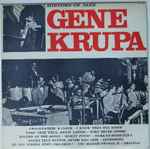 | Gene Krupa | History Of Jazz | © & ℗1971 | Vinyl LP, Compilation | Jazz [Dixie / Bebop / other] | |
 | Gene Krupa | Jazz Spectrum Vol. 9 | © & ℗1971 | Vinyl LP, Compilation | Jazz [Dixie / Bebop / other] |
30Songs
| Song | Year | Records |
|---|---|---|
| Apurksody (Theme Song) | 1971 |
|
| Bloozy Woozy | 1971 |
|
| Bolero At The Savoy | 1971 |
|
| Capital Idea | 1971 |
|
| Coronation Hop | 1971 |
|
| Do You Wanna Jump, Children? | 1971 |
|
| Dracula | 1971 |
|
| Drum Boogie | 1971 | |
| Fare Thee Well, Annie Laurie | 1971 |
|
| Flying Home | - | |
| Gene's Solo Flight | 1971 |
|
| Grandfather's Clock | 1971 |
|
| How High The Moon | 1998 |
|
| I Know That You Know | 1971 |
|
| Idaho | - | |
| Jumpin' At The Woodside | 1971 |
|
| Meddle My Minor | 1971 |
|
| Midget | 1971 |
|
| Murdy Purdy | 1971 |
|
| Never Felt Better, Never Had Less | 1971 |
|
| Overtime | 1971 |
|
| Payin' Them Dues Blues | 1971 |
|
| Perdido | - | |
| Showcase | 1971 |
|
| Sophisticated Lady | - | |
| Swedish Schnapps | 1971 |
|
| Ta-Ra-Ra-Boom-Der-E | 1971 |
|
| The Drum Battle | - | |
| The Madam Swings It | 1971 |
|
| Wire Brush Stomp | 1971 |
|